
Introduction
As Dr. Heather McGee insightfully observes, when it comes to dismantling the root causes of systemic inequities, beliefs matter. These beliefs — or mental models — are our habits of thoughts, assumptions, and taken-for-granted ways of operating that influence how we think, what we do, and how we talk.
As public health professionals seeking to advance health and racial equity, our mental models influence:
- How we understand the roots of the inequity we are trying to resolve
- Who we engage in problem-identification and solution-making, and how we engage them
- Our decisions around policies, practices, and resource flows to solve for the inequity we are trying to resolve
…Laws are merely expressions of a society’s dominant beliefs. It’s the beliefs that must change in order for outcomes to change. When policies change in advance of the underlying beliefs, we are often surprised to find the problem still with us.
The Sum of Us, Heather McGee
We explore core concepts related to mental models and practice uncovering our own mental models and their impact our on work as public health professionals.
Mental Models: What They Are and Why They Matter
In The Water of Systems Change, John Kania, Mark Kramer, and Peter Senge identify six interdependent conditions of systems change that are critical to address, in order to advance equitable systems change. These conditions include:
- STRUCTURAL CHANGE
- Policies: Government, institutional and organizational rules, regulations, and priorities that guide the entity’s own and others’ actions.
- Practices: Espoused activities of institutions, coalitions, networks, and other entities targeted to improving social and environmental progress. Also, within the entity, the procedures, guidelines, or informal shared habits that comprise their work.
- Resource Flows: How money, people, knowledge, information, and other assets such as infrastructure are allocated and distributed.
- RELATIONAL CHANGE
- Relationships and Connections: Quality of connections and communication occurring among actors in the system, especially among those with differing histories and viewpoints.
- Power Dynamics: The distribution of decision-making power, authority, and both formal and informal influence among individuals and organizations.
- TRANSFORMATIVE CHANGE
- Mental Models: Habits of thought — deeply held beliefs and assumptions and taken for granted ways of operating that influence how we think, what we do, and how we talk.
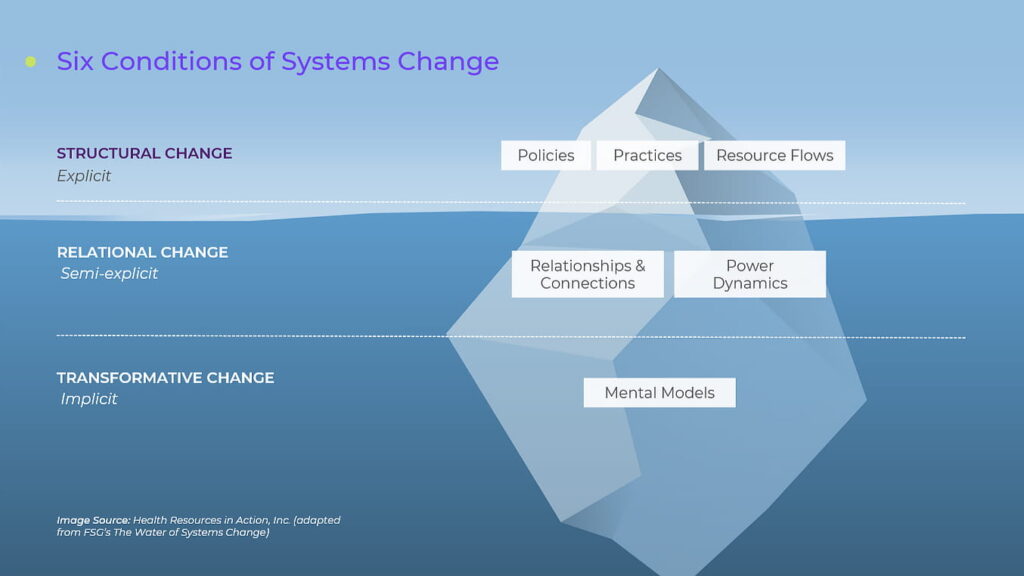
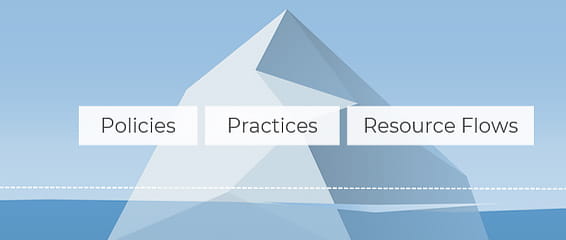
Six Conditions: Structural Change
The image above visualizes these six conditions and their varying level of visibility. So often, governmental public health professionals focus on the tip of the iceberg — what is visible above the surface of the water.
This might include:
- Informing policies
- Promoting evidence-based practices
- Allocating human and financial resources toward stated priorities
These structural conditions are critical to advance systems change, as they can be documented and measured, and their impact can be sustained over time.
Moving down the iceberg: right below the surface of the water, we see relationships and connections and power dynamics. As the water moves around the iceberg, these conditions might sometimes be visible to the naked eye, while other times they are hidden below the surface.
These relational conditions — who knows whom, who has the power to decide, and so on — can inform who is in the room, who has influence, and who is left out of conversations.

Moving deeper below the surface of the water, we get to the bulk of the iceberg — the mental models that we individually and collectively hold. Mental models underpin our relationships and connections, and policies, practices, and resource flows.
Our mental models, when examined, can bring foundational stability and sustainability to equitable policies and practices, but can also hold inequities in place when not.

Reflection Questions
Consider the following questions:
- What condition(s) do you focus on most in your work?
- What conditions are you most excited or curious to explore further?
Bridging Head and Heart
Bringing Our Whole Selves for Community Transformation
The six conditions of systems change give us the opportunity to address the root causes of inequities, and to advance more equitable approaches both systematically and holistically.
While we seek to transform visible policies, practices, and resource flows, we also must attend to the relationships, connections, and power dynamics inherent on our teams and in our community-based engagement. To do this, we must explore our mental models of how we work together, and find ways to foster collective leadership and ownership of the systems we seek to change.
“People created and maintain these systems, and it will take transformed people and relations to shift the systems. We need to shift people’s perspectives and relationships within the system because expanded perspectives and relationships allow us to enact systems change more profoundly and effectively, and ultimately make transformation stick.”
Farhang, Lili and Solange Gould. Framing Systems Change. Racial Justice and Power Sharing: The Heart of Leading Systems Change.
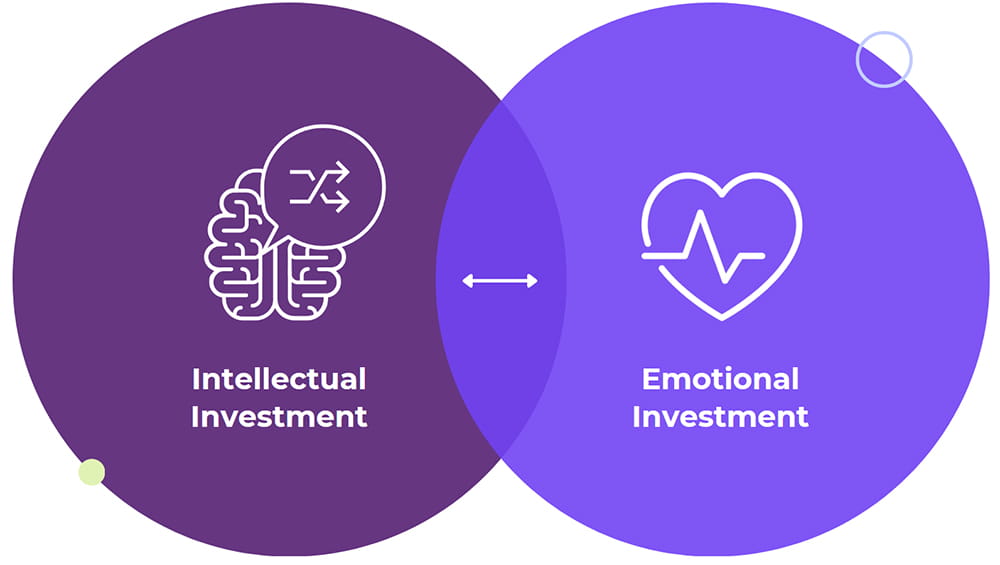
Equity work is an ongoing process, where there is always room to expand perspectives and relationships. We must constantly challenge ourselves to bring both our “head knowledge” (e.g., data, history, assessments and analysis of practices and policies, etc.) and our “heart work” (e.g., lived experiences, identities, trauma and healing, recognition of implicit biases or assumptions, etc.) at the individual level, in our workplaces, and with the communities that we engage and partner with.
Poem Story
The following activity provides a structured way for health departments and other public health professionals to reflect on what it means to bring forth our heads and hearts into equity-focused work.
An Ecosystem of Justice:
How Neighbors Can Be, Elissa Sloan Perry
To illustrate what it means to bring forth our heads and hearts into equity-focused work, listen to this reading of an excerpt from a poem story called “An Ecosystem of Justice: How Neighbors Can Be” (Elissa Sloan Perry of Change Elemental). Read along with the text on the screen, or close your eyes and listen as the poem story is read to you.
Reflection Questions
After listening to the reading, reflect upon the following:
- One thing you learned (head)
- One thing you feel (heart)
- One thing you can do with this information (hand)
- One lesson you could take for your public health practice (feet)
Reflect on this quote:
“Systems Change pursued without Deep Equity is, in our experience, dangerous and can cause harm, and in fact leaves some of the critical elements of systems unchanged. And ‘equity’ pursued without ‘Systems Change’ is not ‘deep’ nor comprehensive at the level of effectiveness currently needed.”
Petty, Sheryl, Leach, Mark, Change Elemental. Systems Change and Deep Equity. 2020
The public health field has been undergoing a mental model transformation with the increasing recognition that addressing social determinants and root causes is central to the field. As depicted by this framework, addressing upstream factors is key to tackling inequities.
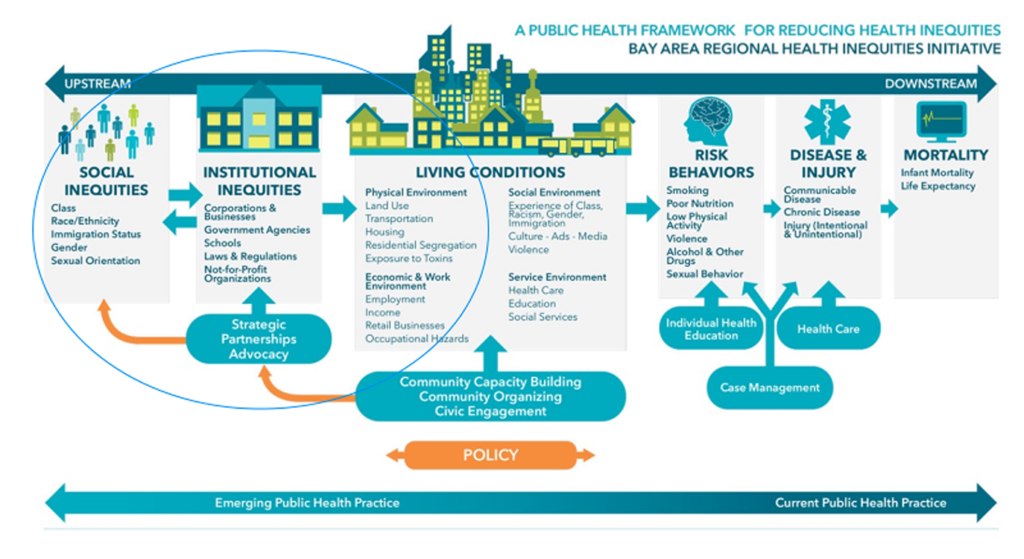
Expanding Our Mental Models to Advance Equitable, Community-Engaged Systems Change
As public health practice intentionally moves upstream to address institutional and social inequities, we must also engage with the communities most affected by the inequities you are trying to resolve.
Communities closest to the pain — or those most affected by the inequities — must be engaged to define the roots of the problem, illuminate the insidious ways that systems do not work for them, and build transformative solutions.
Those with power to decide are often quite distant from those who experience the system’s harms and burdens… [and] people who bear the brunt of broken, inequitable systems…are the furthest from formal centers of power. And all these dynamics are racialized.
Lili Farhang and Solange Goulde, Racial Justice and Power-Sharing:
The Heart of Leading Systems Change
Challenging Mental Models in Community Engagement Practice
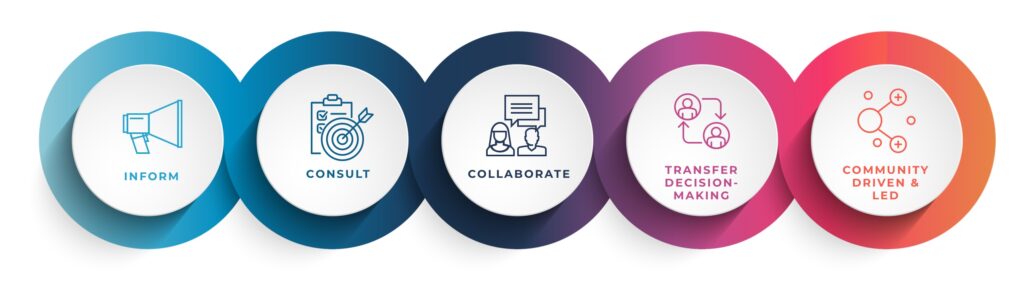
Now consider the Community Engagement Spectrum, a tried-and-true tool showing that the methods of engagement with community exists on a continuum. Importantly it demonstrates that as you move farther and farther up that continuum the more co-ownership of the issues you are working to address get realized.
Equitable Community Engagement Toolkit: Section 1
Equitable Community Engagement Toolkit: Section 2
Community-Engagement Spectrum
What would it take to move up the levels of the Community Engagement Spectrum to deepen and sustain how we engage community?
INSTRUCTIONS:
- Download the Community Engagement Spectrum worksheet.
- Review each level and the categories underneath each (what is the promise to the public, what it means, what it looks like in practice, etc.).
- Take 10 minutes and think of 3-5 projects or initiatives you are working on where you are engaging in some way with the public.
- Identify where these activities currently sit on the spectrum.
- Consider: What influences your approaches to community engagement?
Reflection Questions
Community Engagement Spectrum debrief
- What stands out to you? What surprises you?
- What are some of the assumptions and taken-for-granted ways of operating that influence how we think, what we do, and how we talk about community engagement?
- How would you challenge your mental models to deepen and sustain your approaches to community engagement? What might you need? What stands in the way?
- What did you learn, and how can you take it to program-level decisions?