
What is health equity?
Health equity is both a process and an outcome — meaning, equity lies in not just the elimination of disparities in health, but in how we get there in the first place.
- As an outcome, equity is achieved when a person’s social position or social identity no longer predicts their health, education, income, and well-being.
- As a process, equity requires valuing all people equally, recognizing historical injustice, and providing resources according to need.
To understand and address why certain health outcomes and disparities exist, public health practitioners must constantly reflect upon and address the social, economic, and physical determinants of health that shape the conditions in which people live, as well as the historical and contemporary injustices and systemic oppressions that create and perpetuate these conditions.
In this module, we will build a shared understanding of health equity and deepen our ability to identify or recognize root causes for inequities that exist in the communities we serve.
The Difference Between Equality and Equity

It is critical to understand the difference between equity and equality in order to reduce disparities in health and specific determinants of well-being.
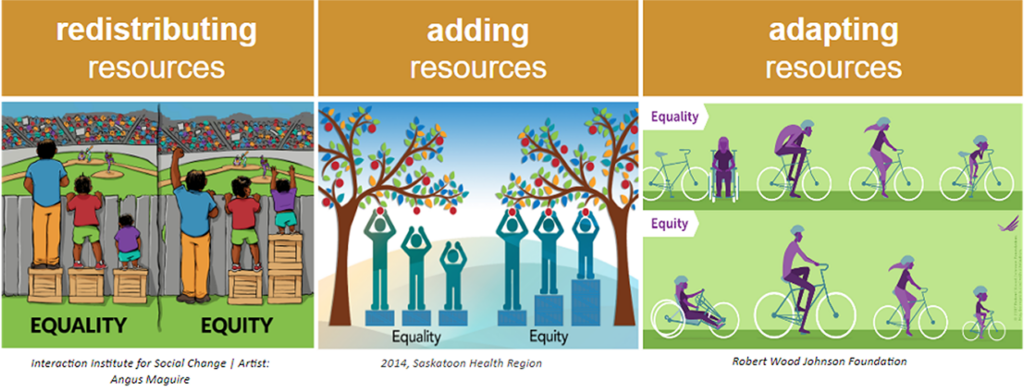
Equality means each individual or group of people is given the same resources or opportunities.
Equity means each individual or group of people is allocated resources based on need and/or unique circumstances to reach an equal outcome.
“The route to achieving equity will not be accomplished through treating everyone equally. It will be achieved by treating everyone justly according to their circumstances.”
Dr. Paula Dressel
Race Matters Institute
Equality vs. Equity
This figure illustrates the key differences between equality and equity and emphasizes three strategies for public health practitioners to promote health equity in our work.
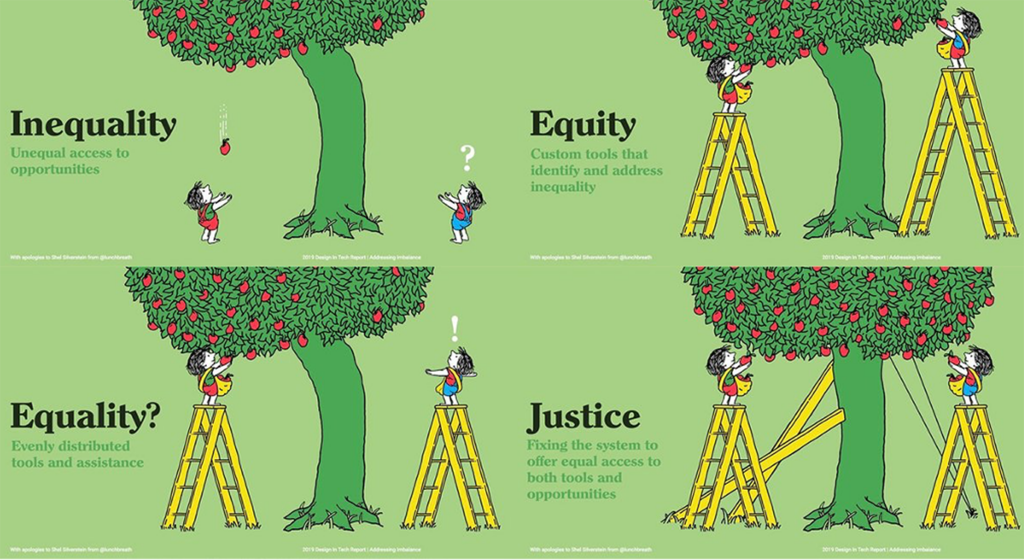
Addressing Justice
Going one step further, justice is a long-term solution that creates equity in systems as well as individuals. While the strategies of redistributing, adding, and adapting resources is important in addressing the inequities experienced by individuals, it is critical to not lose sight of addressing the systems that perpetuate inequities.
Reflection Questions
Describe an example of where you have seen an individual or organization work to redistribute, add, or adapt resources in order to further equity efforts.
Consider the following questions:
- What prompted the inclusion of one or more of the strategies to advance equity?
- Who made the decision?
- What other partners contributed?
- What made this process successful? What were the barriers to success?
Understanding Root Causes of Racial Inequity
In order to achieve health equity, it is critical to also address racial inequity. Historical and contemporary injustices have been and continue to be detrimental to the health, wealth, and well-being of oppressed racial and ethnic communities throughout the United States.
Racial inequity is maintained through systemic practices that lead to:
- Housing discrimination
- Neighborhood segregation
- Decreased availability of jobs
- Exposure to environmental pollutants

These are all reinforced and perpetuated by structural inequities that are evident across institutions. They exist within policies and practices, power dynamics, resource distribution, and even the strategies developed to reduce health disparities.
With just a brief scan of the current landscape across the US, the evidence of structural racism and its impact on marginalized communities is both clear and abundant.
Cities like Jackson, Mississippi, and Flint, Michigan have been plagued with lack of access to clean water due to racism — in the form of redlining and segregation, mismanagement of municipal services, and outdated infrastructure — all disproportionately impacting Black communities. This are two example of how structural racism reveals itself across systems and challenges us as public health professionals to reframe and reimagine our efforts with communities.
To deepen our understanding of the root causes of inequities, we will briefly explore ideas from the Racial Equity Institute and Dr. Camara Jones.
The Groundwater Approach
Described in a brief from the Racial Equity Institute,
The Groundwater Approach tries to help practitioners at all levels internalize the impact of a racially structured society on inequity. Such an approach moves away from attributing disparate outcomes to individual factors or local systems of care, in favor of recognizing deeper causes. A “Groundwater Approach” is based on several key observations about racial inequity.
Key Observations
- Racial inequity looks the same across systems
- Socioeconomic difference does not explain the racial inequity
- Systems cause the inequity
Before moving on, read The Groundwater Approach here

Racism in America
Watch Dr. Camara Jones in “Racism in America” describe the historical roots of racism in our systems and why racial inequities persist to this day.
Reflection Questions
Consider the following questions After Reading The Groundwater Approach and watching Racism in America:
- What was familiar? What felt new or served as an important reminder?
- How does systemic racism show up in the inequities you are trying to resolve, historically and today? How does that shift your previous understanding of the root causes of inequity?
- Who do you need to engage to more deeply understand the roots of the inequity we are trying to resolve? How might you engage them?