
Introduction
Modules 1 through 3 explored core concepts related to health equity, mental models, and power. Importantly, we have applied those concepts to our individual experiences, reflecting on our understanding of health equity, considering the mental models that influence our efforts, and analyzing how and where we bring our power and influence.
This module, however, takes us beyond individual examination and critique.
In this module, we will ask how we can broaden our mental models to integrate approaches that more intentionally include community voices and build community power.
The 5 WHYs: A Root Cause Analysis Activity
1. Understanding Oppression
Given public health’s commitment to advancing health equity, it is critical to develop a practice that accounts for the factors — i.e., root causes — that sustain oppression.
OPPRESSION – When a group of people, typically connected by a dimension of shared social identity (e.g., race), is prevented from having opportunities as a result of a misuse, abuse, and/or imbalance of power.
2. The Why Technique
A simple (but necessary) process to unpack the root of the public health issues we are trying to address is to ask “why” — at the onset of any initiative or as a component of critically reflecting on activities already in implementation.
This technique is most effective when public health departments engage people who have lived experience of the process or problem in question, but it is also useful as an individual or internal team activity to start unpacking our assumptions and challenging our mental models.
3. Challenging and Understanding
We recognize that the root cause of most public health issues is racism, in one form or another. When we ask ourselves “why,” we are unpacking the insidious nature of racism.
We are seeking to dig deeper to challenge our own mental models, and to identify the many intermediary ways that systems we engage with perpetuate racial inequity and systemic oppression.
Why is it happening?
Think about any issue that you or your team are currently grappling with and what you hope will change.
Ask Yourself:
- What policies, practices, or systems are in place that prevent a more equitable future from becoming reality?
- Ask yourself why those policies, practices, or systems are in place and keep asking “why” at least five times.
- The goal is to start with the most obvious answer to the question “why” — and then keep digging to get to the root of the problem.
THEN…
Engage communities most impacted by the inequities you are seeking to resolve to deepen your analysis of the issue you or your team are currently grappling with.
EXAMPLE 1:
Achieving Birth Equity Through Systems Transformation (ABEST)
In Michigan, Black and Native American maternal and infant mortality rates are 2-3 times higher than the rates of White birthing persons and babies. Why?
Traditional, evidence-based approaches to address this inequity included activities like:
- Increasing access to quality, affordable healthcare
- Increasing access to fresh, healthy fruits and vegetables
- Providing implicit bias training for healthcare providers
While these efforts are important, they aren’t enough to dismantle deeply rooted systemic racism. Through intentional partnership with Black and Intertribal collaboratives in MI, ABEST identified the need to move from impersonal, medicalized birth experiences to a whole-person birth experience that holds tradition and culture at the center.
Approaches with these root causes in mind include:
- Centering mothers, parents, and families as the experts and engaging them in ways that honor tradition and culture
- Ensuring every pregnant person has access to supportive services in resource-rich environments
- Expanding pregnancy care and birth options
Black and Native American maternal and infant mortality rates are 2-3 times higher than the rates of White birthing persons and babies.
WHY?
Maternal stress
WHY?
Access to and utilization of quality, affordable pre/post-natal care
WHY?
Lack of trust in medical providers/healthcare institutions
WHY?
Multi-generational history of providers acting on implicit and explicit biases
WHY?
Medicalization of childbirth and devaluing (or eradication) of traditional practices
Source: Health Resources in Action and Michigan Public Health Institute, Advance Birth Equity Through Systems Change, 2022
EXAMPLE 2:
Food Inspections
In a Massachusetts community, Asian cuisine restaurants were failing food inspections at high rates, putting residents and restaurant workers at risk.
Traditional, evidence-based approaches to address this issue included activities like:
- Issuing compliance orders
- Increased inspection cycles
- Providing educational materials
By completing a root cause analysis, a public health professional working to address this challenge can better understand the power of education and relationships over enforcement.
Approaches with these root causes in mind include:
- Focusing on public health workforce capacity, while building on cultural differences and recognizing ingrained stereotypes
- Identifying policy shifts like using fines as the last resort and providing translated materials
- Providing direct support to restaurants in the form of food code educational consultants with lived experience to provide onsite training
Asian cuisine restaurants are failing food inspections at high rates, putting residents and restaurant workers at risk.
WHY?
Lacking information related to food code standards.
WHY?
Lack of access to culturally and linguistically relevant information
WHY?
Information available only in English, not educational, and public health workers are seen as threatening
WHY?
Sanitary code developed as an enforcement mechanism, public health workers are trained as enforcers, most code inspectors are white and male
WHY?
Paternalism (we know what’s best) and ingrained racial/ethnic bias (“they” are choosing not to comply)
Source: Health Resources in Action, 2022
Moving from Asking Why to a Focus on Who
The 5 Why’s dig into root causes. Now, let’s apply that to how we might center the lived experiences of people to address health inequities using a Racial Justice Reframe Tool from the Massachusetts Department of Public Health.
Complete this activity through a series of expanding conversations.
- Start by giving yourself 15-30 minutes to complete this activity individually.
- Then engage a few members of your team and walk through the activity together, giving your team at least 30-45 minutes.
- Note what changes occur as you bring in new perspectives of those that you engage over time. Be sure to consider the diversity of identities of those on your team, centering those most impacted by systemic inequities wherever possible.
- Do this several times, building to a place where you feel ready to use this tool directly with people with the lived experience of whatever public health issue you are working to address.
What does your existing work look like?
The Racial Justice Reframing tool can help challenge your mental models, and should be revisited routinely. It is also designed to demonstrate how engaging with community and different perspectives can shift how we think about and implement public health activities. The tool uses 5 Framing Elements to make explicit the mental models underpinning how we think about and address an issue and to make explicit juxtapositions between different ways of understanding an issue. Use it regularly for quality improvement, annual review of a program, for strategic planning, and more.
Open the worksheet and answer the questions for the Existing Approach column
- Name a public health issue that is of particular interest to you. How has that issue traditionally been described?
- What is the cause of that problem? How does society generally view who or what is responsible for it?
- What is the solution? How does society generally view who or what needs to change?
- What action is needed? What are the typical types of actions (e.g. public health programs/interventions) that come from the way your solution was framed?
- What values are highlighted based on how the causes and solutions have been described? What mental models are most apparent (e.g. individual choice, etc.)?
Let’s Reframe:
Where is the burden of change falling?
By taking the existing path, the burden of change most often falls on the people who are experiencing the consequences of systems that don’t work for them. If we’re going down the racial justice path we are naming and trying to do something to change the systems that cause and perpetuate inequity. In other words, is the burden of change being placed where it should be?
Answer the questions again but this time…
- Name a public health issue that is of particular interest to you. Are subgroups affected differently? Are specific groups bearing a greater burden?
- What is the cause of that problem? Remember the 5 Whys: what are the various root causes of the problem? How do social determinants of health factor in?
- What is the solution? What can be done to address the issues identified in step 2? What needs to shift or change at the community level to make a difference?
- What action is needed? What specific policies need to be implemented, what types of multi-sector partnerships might be needed?
- What values are highlighted based on how the causes and solutions have been described? What mental models are most apparent? Are they any different?
Racial Justice Reframing Tool
| Framing elements | Traditional approach | Racial justice approach |
|---|---|---|
| What’s the Problem? | ||
| What’s the Cause? What/Who’s Responsible? | ||
| What’s the Solution? | ||
| What Action is Needed? | ||
| What Values are Highlighted? |
For a completed example of this tool with more fully described probing questions see pages 13-16 of Massachusetts Department of Public Health’s Racial Equity Data Road Map1.
Your next steps are to take this tool to your team and start using it on an issue you are working through.
The goal is to build to a point where you are asking these questions directly with the people who are experiencing the inequity that you are seeking to address. The tool can be used to work through a public health issue, or it can be used to critique a specific program.
1. https://www.mass.gov/doc/racial-equity-data-road-map-pdf/download
Let’s Reframe:
Community Engagement Practices
This activity asks you to use the same process of juxtaposing existing practices with the racial justice reframing but focused specifically on community engagement practices, norms, and beliefs.
Download the tool for specific community engagement probing questions
PROBING QUESTIONS
- Are racial outcomes different? What other differential outcomes of interest are notable by other population groups?
- What is the inequity of interest? Where/What is the injustice (the source of the inequity) related to the problem?
- Do the solutions address racial or other inequities by helping to dismantle structural racism or other structural causes of inequity (either through policies or systems related change)?
- Do the solutions and actions address the root causes of the inequities identified?
- Do the solutions fall solely on individuals? Where is the burden of change falling?
- Are the actions creating direct benefits for the populations experiencing inequities?
Initial concept developed by Race Forward and adapted for use by the Bureau of Community Health and Prevention, Massachusetts Department of Public Health
Reflection Questions
RACIAL JUSTICE REFRAMING FOR COMMUNITY ENGAGEMENT DEBRIEF:
- How did this exercise help you expand your mental models for community engagement?
- Who else would you want to engage to go deeper? From your team? From impacted communities?
- What practical next step can you take to apply learnings from this exercise?
- So how do we broaden who we are engaging with?
- How do we approach it from a strategic vantage point where power is a core consideration?
Partner Identification Core Questions
Almost any community engagement activity will ask: who needs to be engaged? These four questions make explicit (bring up to the surface) the implicit mental models we hold. Keep these questions in mind as you consider who needs to be engaged and why.
WHO is benefiting?
Through our decisions and actions, who will most directly benefit and how?
WHO is being harmed?
Will our approaches lead to any unintended consequences, particularly for those most affected by the inequities we are trying to resolve, and how can those consequences be mitigated?
WHO is leading and who could be?
To what extent do our methods increase leadership opportunities for communities of color and other disproportionately impacted communities?
WHO is deciding?
Will we be transparent in how decisions get made, and will our actions create different ways of operating that place more choice in the hands of those most affected by the inequities we are trying to address?
Stakeholder Analysis Using Power and Influence
Now let’s get specific.
- Are there organizations, people, or groups that should be included but are not included yet?
- How do we build influence among those who have less power and influence?
- How do we cultivate interest, support, and vision among those most impacted?
In order to answer these questions, we need to know who the stakeholders are in our community. By gaining a better understanding of these stakeholders, we can create a power map like the individual power map from Module 3, but for a public health program we are implementing. This can help you identify the individuals to engage in the early stages of the desired movement, so that you can come together to build strong partnerships and find possible solutions.
ACTIVITY
The Stakeholders Analysis Matrix
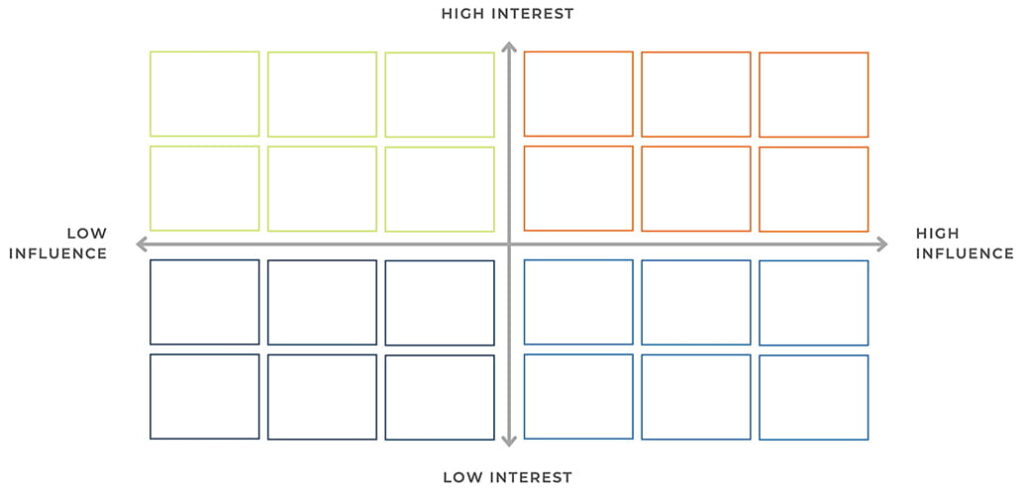
Reference the list you created via the Partner Identification activity. Now download the “Stakeholders Analysis Matrix” and place them on the grid.
This brainstorming activity helps us illustrate where the power dynamics exist and can drive our strategic efforts moving forward. A clear overall strategy helps to drill down the message so that you can allocate time, money, and effort where they will best advance your goals.
Follow-Up Questions
Once you have mapped the influence (or power) and interest of members of your community, consider the following questions to help you develop your overall strategy. Answers to these questions will determine not only what actions you take, but how you communicate those actions.
- What is the change you want to see?
- Who has power over the resources or decision-making process?
- With whom do you need to build power?
- How do we cultivate interest and influence, particularly among those who are closest to the inequities we are working to address?
Moving to a new state of community engagement practice
In Module 2, you challenged your personal mental models and reviewed the Community Engagement Spectrum to assess where your current practice is situated using several of your own program examples. In Module 3, you considered personal power and assets. In Module 4 you have been practicing challenging mental models and applying power concepts to public health program examples.
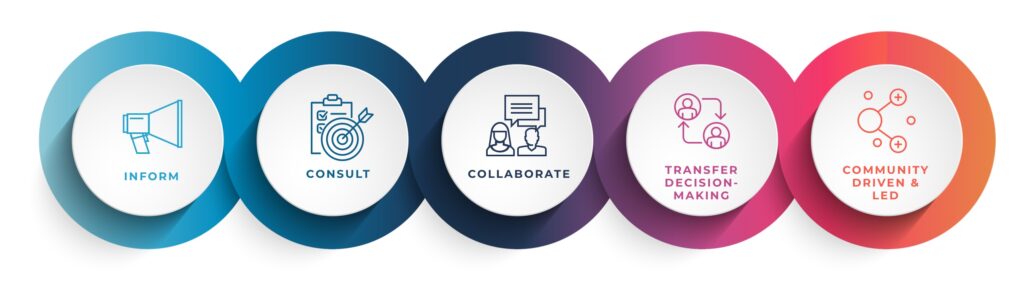
Let’s use the Community Engagement Spectrum again and see what changes are coming up.
As you did in Module 2, start with downloading the Community Engagement Spectrum worksheet. Using the same 3-5 projects you ran through then, or using new ones, consider the following questions:
- The 5 Whys provided examples and a demonstration of what a structured root cause analysis can accomplish. How might you apply that process to where on the spectrum your practices are landing? For example, if your practices are regularly landing on “Consult”, why?
- The Racial Justice Reframing Tool gave you a method to take a public health issue or program and make explicit and tactical juxtapositions between existing and equity focused practices related to it. Consider using the questions in the tool to critique whether a choice to be at an “Inform” or “Consult” level addresses key equity factors? For example, where is the burden of change falling if you are Informing or Consulting on an issue?
- Having gone through a power mapping activity, how does that process shift how you think you need to be engaging with the people you want to cultivate influence with or best leverage the power they have related to the issues you are outreaching about?
Bringing it All Together
As you explore how to authentically engage community and shift power to address the outcomes of the root causes of inequities, consider these four questions to make explicit (bring up to the surface) the implicit mental models we hold:
WHO is benefiting?
Through our decisions and actions, who will most directly benefit and how?
WHO is being harmed?
Will our approaches lead to any unintended consequences, particularly for those most affected by the inequities we are trying to resolve, and how can those consequences be mitigated?
WHO is leading and who could be?
To what extent do our methods increase leadership opportunities for communities of color and other disproportionately impacted communities?
WHO is deciding?
Will we be transparent in how decisions get made, and will our actions create different ways of operating that place more choice in the hands of those most affected by the inequities we are trying to address?